
The analysis concerned a modification to an existing circuit that had been in operation for decades: the rerouting of the bend zone of a large-diameter, high-temperature, low-pressure line. The intervention itself was modest. Doing it correctly required understanding the design philosophy of the existing line, and representing elements — bellows and fixed points — whose real behaviour is easy to oversimplify.
- Line
- DN 750 (OD 762 mm), mitre bends
- Temperatures
- 650 °C on the first section, 450 °C on the second
- Pressure
- Below 0.5 bar — outside the scope of the Pressure Equipment Directive
- Software
- Bentley AutoPIPE
- Scope
- Local check between two fixed points for the rerouting of the bend zone
Bentley AutoPIPE was chosen for the robustness of its solver with non-linear supports: many restraints, closely spaced and with gaps, converge quickly and reliably.
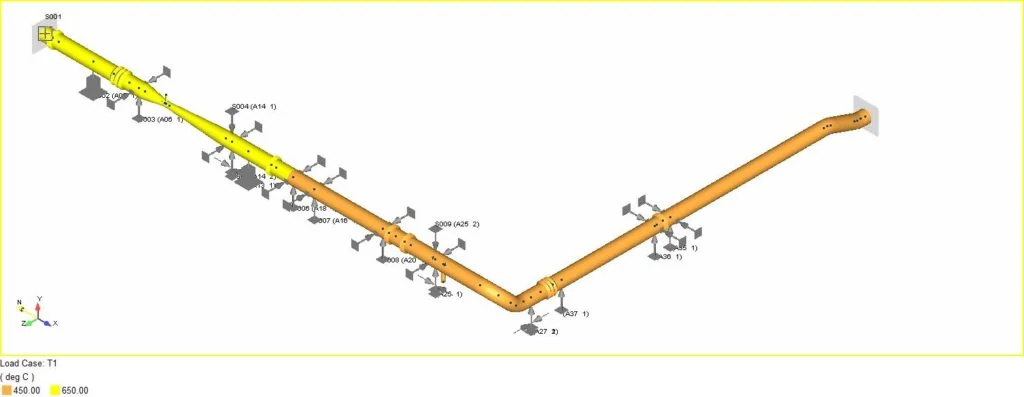
The client's constraints
- Perform a local check between two fixed points, without extending the model to the whole circuit.
- Exclude, where possible, the existing bellows outside the modified section, whose construction data were not available.
The design philosophy of the existing line
At these temperatures the circuit looks complex, but it was designed in a deliberately simple way. The line is divided into elementary sections between line stops, and each section contains one or more bellows that absorb its own thermal expansion locally. At such a low pressure, simple untied bellows are a sound choice, because the pressure thrust they transmit to the fixed points remains modest. Any modification must respect this logic rather than work against it.
Bellows are hinges, not just expansion absorbers
A bellows absorbs axial growth, but it also introduces a structural hinge. What would otherwise be a continuous beam becomes a chain of segments joined by flexible elements, and without proper support it turns into a mechanism. This is why a guide is installed immediately upstream and downstream of each bellows, and why ignoring the bellows in the model is an error even when their data are unknown.
The client's request was therefore translated into a precise modelling choice: bellows with a high axial stiffness — so that no credit is taken for axial absorption that could not be verified — but with angular and lateral stiffnesses typical of commercial products, so that the instability they introduce is fully represented.
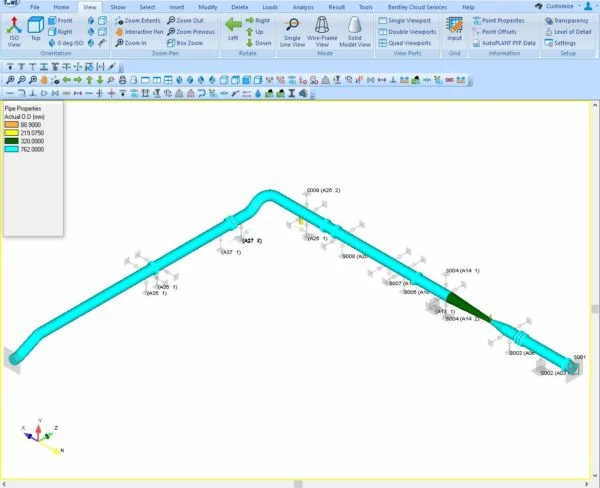
How fixed is a fixed point?
Modelling a fixed point as a perfect anchor is neither conservative nor realistic. Upstream of anchor S001 the line continues for a short distance and then turns vertically, so the thermal growth of that portion can impose a rotation at the battery limit of the section under study. Two bounding approaches were analysed:
- Imposed rotation: no movement of the anchor in the design condition, and an imposed rotation about the vertical axis in the operating condition.
- Released battery limit: since two consecutive bellows with an intermediate spool behave as a universal expansion joint, only a vertical support was kept at the battery limit, letting the line absorb unexpected movements.
Comparing the two bounds the real behaviour of the system and shows whether the conclusions depend on an assumption that cannot be verified on site.
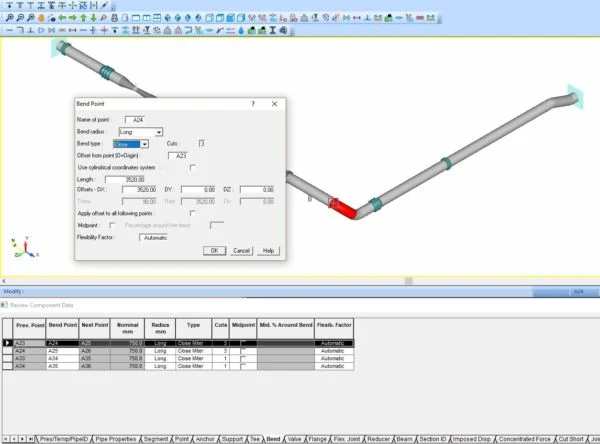
Mitre bends
For very large diameters at low pressure, piping specifications often prescribe bends fabricated from pipe segments instead of standard elbows. Their stress intensification and flexibility factors depend on the number of cuts and on their spacing, and differ significantly from those of a smooth elbow. AutoPIPE derives them from the number of cuts and the bend radius, so the geometry must be entered as built rather than approximated with an elbow.
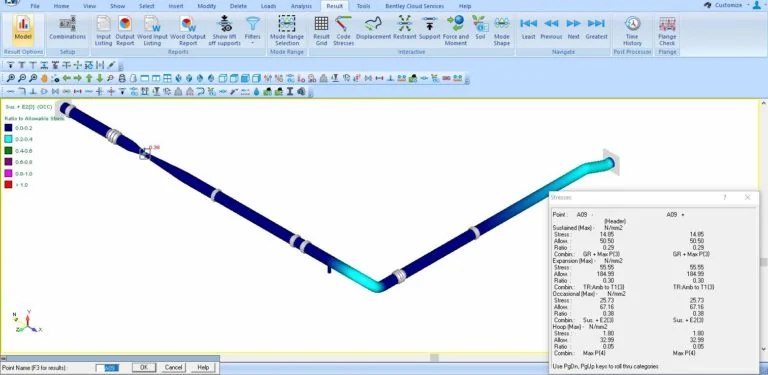
Results
Despite the high temperatures, the stress ratios are low along most of the line. They rise only at the geometric and structural bottleneck of the layout — a natural weak point of this type of system — which became the focus of the recommendations for the new routing.
Key points for bellows on hot, low-pressure ducts
- Never omit bellows from the model: they are hinges, and the line between them must be guided and supported.
- If bellows data are unknown, take no credit for axial absorption but keep realistic angular and lateral stiffness.
- Bound the behaviour of "fixed points" with at least two boundary assumptions.
- Model mitre bends with their actual number of cuts: their SIF and flexibility are not those of an elbow.